
How Google Sites Could Crush WordPress (If Google Ever Decided To Try)

1. How Google Sites Could Crush WordPress (If Google Ever Decided To Try)
The Sleeping Giant
WordPress powers more than 40% of the web. It’s the go-to platform for everyone from solo bloggers to global brands. But quietly sitting in the background is Google Sites — a free, integrated, nearly invisible tool that most people underestimate.
While WordPress dominates through flexibility, plugins, and a vibrant developer community, Google Sites hides in plain sight, offering simplicity, speed, and zero maintenance. It’s not glamorous, but it works — and it’s backed by Google’s unmatched ecosystem.
The Comparison: Power vs. Platform
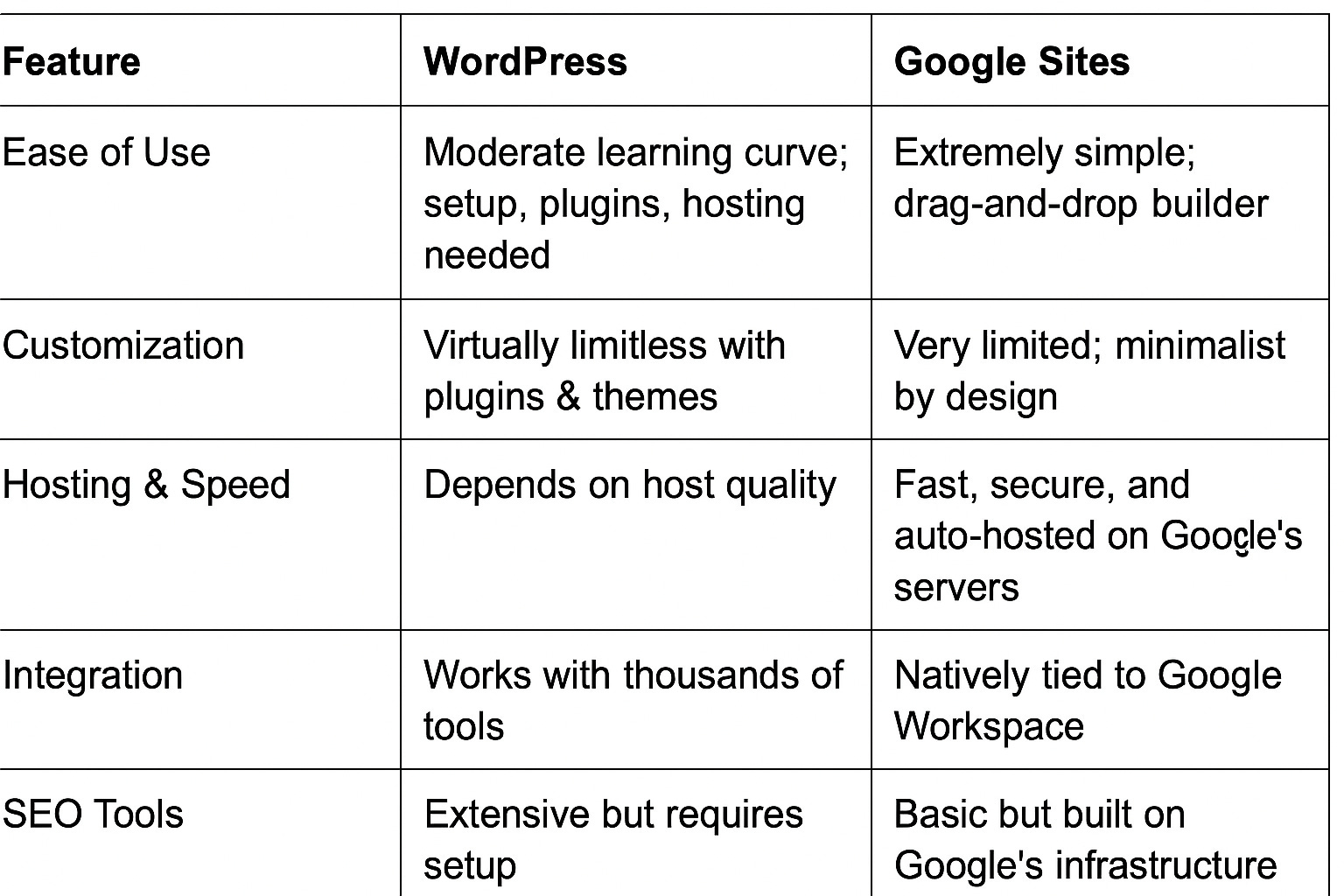
WordPress wins on versatility. Google Sites wins on simplicity and reliability. But here’s the thing — Google hasn’t even tried yet.
What Happens If Google Cares
If Google ever chose to update Sites — adding APIs, app integrations, monetization, SEO management, and even a marketplace — it could instantly level the field. Imagine building and publishing a website directly from your Google Drive, backed by Gmail, Docs, Sheets, and Search Console in one unified workflow.
That would make Google Sites not just a competitor — but an existential threat to WordPress’s dominance.
The Real Question
The only reason Google Sites isn’t crushing WordPress today is because Google hasn’t pointed its full attention toward it. If they ever do, it wouldn’t just change how websites are built — it would redefine what a “website platform” even means.
2. Blogger.com: The Forgotten Powerhouse That Could Rise Again
A Platform That Defined the Early Web
Before Substack, Medium, or WordPress, there was Blogger. Acquired by Google in 2003, it powered millions of voices when the internet was still wild and personal. It made publishing free, fast, and universal.
But in 2025, Blogger feels frozen in time — a relic of web nostalgia. And yet, buried beneath the dust is one of the most scalable, stable, and SEO-friendly platforms ever built.
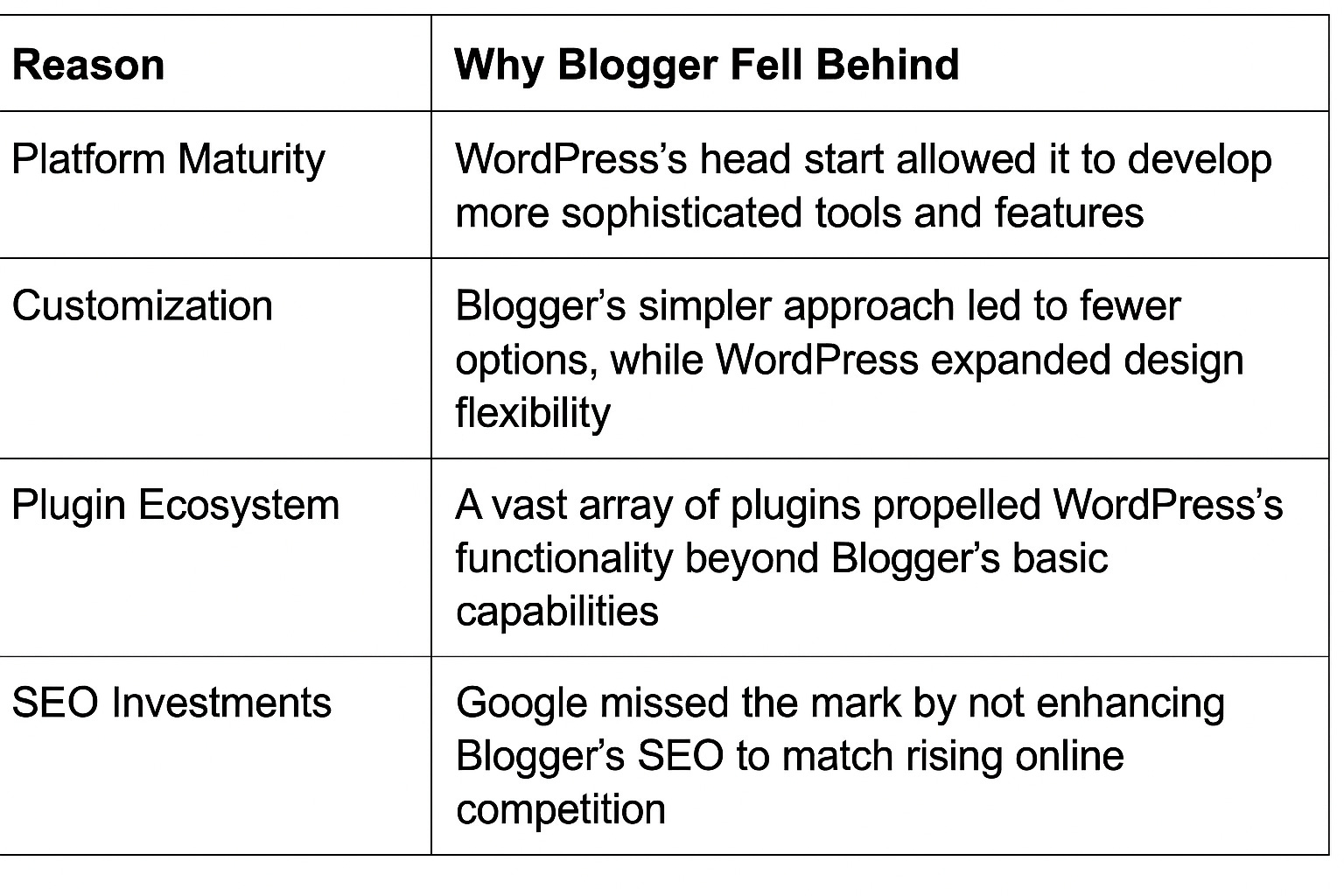
Why Blogger Fell Behind
FactorWhat HappenedInnovation StalledFew major updates in over a decadeUser ExperienceOutdated dashboard and limited modern templatesCommunity ShiftCreators migrated to WordPress, Medium, and social mediaBrand Perception“Old Google tool” rather than a serious publishing platform
Blogger’s decline wasn’t due to weakness — it was due to neglect. Google turned its focus to Search, YouTube, and Android, leaving Blogger to survive on autopilot.
The Untapped Potential
Imagine if Google revived Blogger with:
Full integration with Google Workspace and Analytics
Built-in AI writing assistance
Modern templates optimized for mobile and performance
One-click monetization through AdSense and YouTube
It could become the ultimate creator platform, blending simplicity with Google’s infrastructure and traffic insights.
Why It Still Matters
Despite its age, Blogger remains one of the most SEO-friendly blogging tools ever made. Content ranks fast. Sites load quickly. Hosting is free. The skeleton is strong — it just needs a modern heartbeat.
If Google ever reignited Blogger’s innovation, it wouldn’t just challenge WordPress or Medium — it would reshape the publishing ecosystem overnight.